Posts
Posts



Tuesday, August 6, 2013
Civil Rights Attorney Julius Chambers Dies
There’s a scene in the classic movie “To Kill a Mockingbird” in which the black Rev. Sykes is sitting in the segregated balcony of the courthouse at the end of the trial. When Atticus Finch is leaving the courtroom, Sykes rises, as do all the black people. He tells Finch’s tomboy daughter, Scout, who is sitting with the minister, to stand. She asks, “Why?”
“Because your father’s passing by,” Sykes replies.
All North Carolina should rise at the “passing” of Julius Chambers.
By Barlow Herget
Julius L. Chambers, 2012 AASCU Distinguished Alumnus Award Recipient
Pioneering civil rights lawyer Julius Chambers – a crusader for equality whose landmark cases led to
integrating Charlotte-Mecklenburg schools – died late Friday after months of declining health.
Chambers, 76, a soft-spoken but tenacious and unflappable attorney, fought against racial and
employment discrimination to the end, said his law partners, James Ferguson and Geraldine Sumter, at
a news conference Saturday.
“Our community and our nation has benefited tremendously from Mr. Chambers’ tireless efforts to
ensure that all people are treated equally,” Ferguson told reporters outside the Charlotte firm that
Chambers founded in 1964.
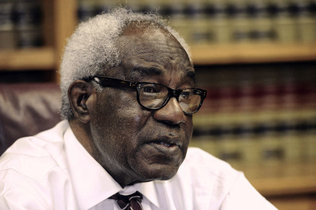
“He believed that regardless of one’s position, status, race, creed, color, religion or gender, everyone has
an obligation to ensure equality for all.”
Over the years, his enemies set his law office on fire, bombed his Charlotte home and his car. They also
torched his father’s shop in his hometown of Mount Gilead.
Yet Chambers, who later served as chancellor at N.C. Central University in Durham, was never
vindictive. And he never quit.“The animosity toward him and his positions was just heavy and real. You could feel it,” said C.D. Spangler, former UNC president, who was elected to the school board in 1972 after Chambers had sued that board and won. “But he never let that change him personally. … He didn’t hate the people who hated him.”
The 1971 ruling in the Swann vs. the Charlotte-Mecklenburg Board of Education case mandated cross-
town busing to end segregation of local schools. It also highlighted the power of federal courts to
intervene when public school systems dawdled on their way to integration.
Chambers took eight cases to the U.S. Supreme Court – including the Swann case – and won every one.
“He was my personal hero,” said U.S. Rep. Mel Watt of Charlotte, who is President Barack Obama’s
nominee to lead the Federal Housing Finance Agency.
After Yale Law School, Watt had offers from firms around the country but returned to Charlotte in 1972
to practice law with Chambers.
“Chambers said, ‘You have an offer right here, and you can make an impact,’ ” Watt said in a 2007
interview. “ ‘Here you can help the people you grew up with. And rather than separating yourself from
them, you can bring them along with you.’ That was a compelling, powerfully persuasive argument.”
Setting a course

Julius LeVonne Chambers was born in Mount Gilead on Oct. 6, 1936. His father, William Chambers –
“Shine” to customers whose Model T Fords he had washed – owned a garage-general store near Mount
Gilead, 60 miles east of Charlotte.
His mother, Matilda, helped out in the store and raised their four children, including Julius and older
brother, Kenneth, a retired Charlotte obstetrician/gynecologist.
In 1949, 13-year-old Julius was looking forward to following his two older siblings to Laurinburg
Institute, a private school for blacks. But one April day, fighting back tears, William Chambers told his
son that the $2,000 he’d saved to send him to school was gone, thanks to a white customer whose 18-
wheeler Chambers had maintained and repaired for months, buying parts out of his own pocket.
That morning, the man had refused to pay the bill and jeered as he drove off with the rig. William
Chambers spent the afternoon going door to door, asking for help from the few white lawyers in town.
They all turned him away.
That was the day Julius Chambers vowed to study law.
Instead of Laurinburg Institute, he attended the all-black public high school in Troy, traveling 12 miles
each way in a cast-off bus from the white school. To supplement the primitive curriculum – students
had to kill and cut up hogs on the principal’s farm – he subscribed to the Book of the Month Club.
“It must have been like pouring water on a sponge,” said George Daly, who practiced briefly in
Chambers’ firm.

Young Chambers did more than keep his promise. He graduated summa cum laude from North
Carolina College in Durham, now N.C. Central, where he was president of the student body. After a
master’s in history from the University of Michigan, he entered the UNC Law School in Chapel Hill,
where, in 1962, he graduated first in his class of 100 and was the first black chosen editor of the North
Carolina Law Review.
At the year-end banquet at the segregated Chapel Hill Country Club, Chambers wasn’t invited.
He didn’t care, said Adam Stein of Chapel Hill, who later was the first white lawyer in Chambers’ firm.
“All sorts of things in society could have created anger and distraction,” Stein said. “But he just plowed
right through.”
After graduation, Chambers, married to Kannapolis native Vivian Giles, was appointed as a teaching
associate at Columbia University School of Law, where he also received a Master of Law in 1963.
Settling in Charlotte
A year later, he and Vivian arrived in Charlotte, where they set up a practice at 405 1/2 East Trade St. in
uptown Charlotte. In his first year, Chambers took on 35 school desegregation cases and 20 suits
charging discrimination in public accommodations. By 1972, the firm had 11 members, including five
whites. Forty percent of its 1,200 cases involved civil rights.
It didn’t take long for him to make headlines – and for his constant prodding for change to draw anger.
By 1965, shortly after Chambers opened his law office, Charlotte-Mecklenburg had partially integrated
some schools. But in January of that year, Chambers sued the school board to force total desegregation.

Days after Chambers filed the Swann suit, his car was bombed during a speaking engagement in New
Bern. As Chambers checked on the car, people in the audience poured into the street, asking, “What
are we going to do?” his partner Geraldine Sumter recalled.
“He said, ‘We’re going to go back inside and finish the meeting. There’s nothing we can do about that
car,’ ” she said. “His demeanor was always calm. He never got upset.”
That June, state Judge Braxton Craven ruled for the school board, concluding there’d been steady
progress toward desegregating schools. The case resurfaced in 1969, when federal Judge James
McMillan ordered CMS to desegregate through busing.Ultimately, Chambers’ lawsuit led to the 1971 Supreme Court ruling that allowed school districts to bus students to achieve racial balance.
Integrating Shrine Bowl
On Nov. 11, 1965, Chambers sued to integrate the annual Shrine Bowl, the yearly high school all-star
football game between players from North Carolina and South Carolina that until recent years was
played in Charlotte.Eight days later, sticks of dynamite blew up at Chambers’ home and the homes of three other prominent Charlotte civil rights leaders.
Chambers and his wife were home in bed when the dynamite blew out a window in the front bedroom.
“I threw up next to the house. I was angry,” he told the Observer recently. “I didn’t know who did it. I
didn’t know why they would do it. I had my ideas. We knew getting with the Shrine Bowl was going to
cause a lot of problems. And it did.”Chambers told the Observer he felt the Shrine Bowl lawsuit was one of his most important civil rights cases.
“We were able to reach a lot of parents, teachers, principals, who played very important roles in black
and white communities,” he said In or out of the courtroom, Chambers’ reserve, his physical compactness, enhanced by neatly cut suits and close-cropped hair, prompted the label “unflappable.”

“A lot of people were surprised to see Chambers in court,” said his partner James Ferguson. “Some
people expected him to be bombastic and always on the attack. Chambers never raised his voice. He
was always very low-key and very calm, and because of this approach, he disarmed the witness.”
John Gresham, a former law partner, said Chambers had a habit of playing with string or a rubber band,
often making a cat’s cradle, while interrogating a witness – lulling the witness into a false sense of
security.
Another tactic, Gresham said, was to start out asking innocuous questions that appeared to be aimed
at finding out very simple things about the company’s policies.
“You could see the witness relaxing and thinking, ‘This guy doesn’t even know how we operate.’ Then
Chambers would very carefully draw a circle around what he wanted to know, and as soon as he had
the loop closed, he would bore in, and you could see the witness thinking, ‘Oh, my God!’ ”
Though his words were few, Chambers’ lessons endured.
Once Chambers sent Watt to Lumberton in Robeson County to defend protestors charged with
resisting arrest and assaulting an officer.
“I get down there,” Watt said, “and I find that these are Native Americans who’d been carrying
tomahawks and demonstrating because they didn’t want to go to school with black kids.”
Back in Charlotte, a confused Watt asked Chambers: “Why in the world did you send me to Lumberton
to defend people who were against going to school with black kids?”
“Julius never looked up,” Watt recalled. He said, ‘Don’t you believe in the First Amendment? Don’t you
believe in free speech?’ ”
Returning to roots
In 1984, Chambers left Charlotte and his firm to become director of the NAACP Legal Defense and
Education Fund in New York.
Of that loss, former Observer editorial columnist Jack Claiborne wrote: “Losing a Julius Chambers … is
like losing a magnet, a force that helps energize the community.”

Chambers was the third LDF director, following Thurgood Marshall and Jack Greenberg.
He returned to North Carolina in 1993, first to the college where he earned his undergraduate degree
to serve as chancellor.
When Chambers arrived in Durham, the school was recovering from charges of financial
mismanagement. He found unsafe buildings that had not been maintained for years, and only one
endowed chair to attract top professors.
Chambers worked to raise the endowment from $1 million to $25 million by 1999. During his tenure,
the university increased the number of endowed chairs to 14.
He raised academic standards and millions in capital-improvement funds. And under his leadership, 80
percent of the faculty had doctoral degrees and the school built new buildings for education and social
work departments.
In 2001, Chambers returned to Charlotte and the law firm he founded. Again he became embroiled in a
desegregation fight after a group of white parents sued the school system, challenging busing and other
race-based policies.

“We’ve made a lot of progress, but I had hoped we would be much further on by now,” Chambers told
the Observer then. “We must continue to bring people together and break down the barrier of
segregation. In Charlotte, busing is still the only way to do that.”
They called him ‘Chambers’
On Saturday, his friends and former law partners at Ferguson, Chambers & Sumter said Chambers was
deeply concerned with recent legislation in North Carolina and around the country that had begun to
unravel his life’s work.
They were left with grief and fond memories of an unassuming man they simply called “Chambers.”
“He was too revered to call him Julius,” Ferguson said. “And it sounded too stuffy to call him ‘Mr.
Chambers.’
“So, for most of us, it was just ‘Chambers.’ ”
In 1999, while he was N.C. Central chancellor, Chambers was diagnosed with cancer – but underwent
treatment and it never returned.
Then in April, he suffered a heart attack.
Still, partner Geraldine Sumter said it was “a shock” when Chambers’ daughter, Judy, called Friday
night with news that Chambers had died.
His wife, Vivian, and mother, Matilda, died last year.
At the end, Sumter said Chambers’ body might have been frail, “but, oh my goodness, the mind was
still so sharp.”
She’d visit him and they’d talk about cases. “He’d say, ‘Hey, how’s Fergy (Ferguson) doing with that
case?’ Or ‘How about bringing me the file on this case?’ He never quit.”
The firm never gave him a retirement party.
“I’m not sure Chambers ever stopped practicing law,” Ferguson said. “We think he didn’t practice law
when he was in the hospital. But if he wasn’t actively practicing, he was concerning himself with people
whose rights were being trampled.
“With Chambers, you didn’t talk retirement – you talked about what’s next.”
Funeral arrangements were incomplete Saturday. Long & Son Mortuary Service is in charge. OBSERVER
STAFF WRITERS DAVID SCOTT AND GARY SCHWAB CONTRIBUTED.
Read more here: http://www.charlotteobserver.com/2013/08/04/4211103/civil-rights-leader-julius-
chambers.html#.Uf5V8rUNEJU.facebook#storylink=cpy
"Mr. Chambers was not the first lawyer of color to try to address the issues of equality," firm partner Geraldine Sumter said Saturday. "He would tell you he had people like Buddy Malone of Durham that he looked to, the Kennedys out of Winston-Salem. The thing that Mr. Chambers brought to that struggle was a very focused, determined attitude that things were going to change."
Julius Chambers: A Struggle for Equal Justice Through the Courts
Anthony D. Ross was homeless

At age 13, I lost my grandmother to heart disease who was the sole caretaker of me at the time, I never
knew my dad, and my mother was a drug addict. After my grandmother died, my sisters and I were
living in my mom's house with no water, heat, or electricity for months due to her drug use. We ran out
of the house when she tried to murder us one night with a meat cleaver.
My sisters and I were separated when some of them joined their father’s side of the family while I
ended up homeless sleeping in cars and homeless shelters in Washington, DC. My aunts on my mother’s
side tried to take care of me but could not. One tried to hit me with a frying pan because she was
always stressed out and the other was an alcoholic who threw my clothes out of her apartment and my
birth certificate and social security card in my face. I then began living with strangers who were friends
with my aunt. They were a family of 14 who lived in a two bedroom section 8 apartment in southeast
Washington, DC.
After living with them for 8 months, I was beat up and had to leave the house once I found out that
they were getting food stamps and welfare benefits using my name. I had no choice but to go back to
the homeless shelter.

I always had to watch my back and protect myself in the shelter because different people would sleep
in throughout the night. I wanted to go to high school so bad but could not because I needed to work
two jobs to feed and clothe myself. I enrolled into a G.E.D. program at age 16 so that I can have time to
work at Starbucks during the day and Ruby Tuesdays during the night and still go to school. After I
earned my G.E.D., I stayed up until three and four in the morning teaching myself algebra,
trigonometry, logarithms, functions, and geometry on the computer from watching YouTube videos
and had tutors come out to the shelter to help me prepare for the SAT/ACT’s. In 2008,
I applied to Saint Augustine’s University. I got accepted and spent 4-6 hours a day in the library studying ahead of the syllabi and earned a 4.0 GPA my freshmen year. Due to me being overlooked in the foster care system, my mentors and friends invited me over to spend the holidays with their families when the
campus close down for holiday breaks.
I interned for the Mayor of Washington, DC, Adrian Fenty, where he and President Obama performed
several initiatives together which I was able to see first-hand and was one of 15 homeless students in
the United States chosen to attend a scholarship banquet on behalf of the National Association for the
Education of Homeless Children and Youth to help draft a Homeless Youth Act to Congress before
receiving awards from the United States Interagency Council on Homelessness. I began working for Dr Cornel West at his Academy of Excellence to help mentor at-risk youth in grades 2nd-6th.
I was inducted into the Alpha Kappa Mu National Honor Society and Pi Gamma Mu International Honor
Society and have been on the President’s and Dean's List since freshmen year. Out of all political
science majors at my University, I won the department award last year. I also interned for Wake
County’s youngest appointed District Court Judge, Vince Rozier, where I learned the fundamentals of
the Judicial System and how it operates. I served three years in the Student Government Association
and was elected Student Body President of the college my junior year.

Now attending Law School at North Carolina Central University.
Monday, August 5, 2013
Stop-and-Frisk: The High School Senior
Kasiem Walters, a high school senior in Flatbush, Brooklyn, speaks about the countless stop-and-frisk experiences he and his friends have had over the years. From waiting outside a friend’s house on the walk to school, to giving high-fives and being mistaken for selling drugs, Kasiem dreams of a time when he and his community can look around and feel like citizens of New York, not criminals.
Monday, July 22, 2013
Saturday, July 20, 2013
Kids React to Controversial Cheerios Commercial
And the Bible says: A little child shall lead them . . . .,
Friday, July 19, 2013
WHO ARE THE ANGOLA 3 (2/2)
Background idnformation on the history of the Angola 3 who were previously Black Panthers. Hence there is an association with the lifestyle and philosophy of the Black Panther Party. Learn the reality of this political group and reject the paintbrush misrepresentation by the general public and media. This is an important history lesson to learn.
After 40 Years in Solitary, Angola 3 Prisoner Albert Woodfox Ordered Fre...
This is the voice of the second one of the Angola 3. This is a man who is a strong brothe who is to be admired. Amy Goodwin and Juan Gonzalez of Democracy Now publicize this human tragedy. Unbelievable that a 3-time overturned case can be ignored and this man remains in prison. HOW CAN THIS HAPPEN?>!?!?!?!?!??????? What must be DONE!!!!!!!!!
Slavery still reigns in US prisons
Would you believe that actual SLAVERY exists today in the United States? It does in the guise of the prison system. Listen and learn with this video. Then follow up and join any movement to abolish slavery in all forms isn the United States today. Our ancestors require this.
Wednesday, July 3, 2013
Jill Scott - Family Reunion
"Family Reunion" by Jill Scott which is new to me and beautifully described. Relaxing music and wonderfully words of fantastic memories we will all long cherish. We got to play this at our family reunion too. Hey, Music Guys, get on this right away -- for sure !!
Friday, June 28, 2013
Long Distance Revolutionary: A Journey with Mumia Abu-Jamal (official tr...
Mumia Abu-Jamal And Filmmaker Stephen Vittoria Talk American Imperialism

Prison Radio / Nolan Edmonston
Mumia Abu-Jamal has been serving a life sentence (he was formerly Death Row) for the murder of a white policeman in Philadelphia since 1981. In that time, he's been heralded as a revolutionary and condemned as a killer, written hundreds of books and essays, sparked a massive Free Mumia movement and lent support to contemporary calls for change like Occupy Wall Street. He's also the subject of director Stephen Vittoria's (One Bright Shining Moment) newest documentary, Long Distance Revolutionary: A Journey with Mumia Abu-Jamal, which follows Mumia—who has always insisted he's innocent—from his early involvement with the Black Panthers to his career as a radio journalist in Philadelphia, through his current period of incarceration and his published works.
We recently spoke with Mumia and Vittoria about the film, the media, and what it means to fight for change in a modern world.
Steve, what made you want to document Mumia's life? And Mumia, how did you get involved in the project?
SV: You wake up in a country that's run by mass murderers, economic rapists, and general run-of-the-mill racists and misogynist psychopaths, and you start to look for some sanity. And for me the sanity and inspiration came from a gentleman writing from a dark, dank hole on death row in Pennsylvania. I wanted to focus on a very unfortunate but remarkable life as a journalist a writer, a historian, an author, and a revolutionary from day one. There needs to be another narrative told about the life of Mumia, because the narrative that's been told for 30 years has been an utter lie.
MAJ: We started with a little project, a book, and it migrated to a film. But as all projects, they have a life of their own. And they sometimes are greater than the imagination of either or both of the parties involved. We were going to do a work called 'Murder Incorporated.' The title does not refer to a mafia movie. It refers to LBJ who when he took over as president of the United States, looked at what was happening in the Caribbean, and told someone: "Whoa, we're running, like, Murder Incorporated down here." And it seemed like a perfect title.
But it's really a study of imperialism. And, as ever, imperialism never remains overseas. It creeps back home. It creeps back home through torture. It creeps back home through repression. It creeps back home through secret prisons. And it creeps back home through corruption of the legal system. And what we see is what we've done.
Mumia, do you consider yourself more of a writer than a revolutionary, or do the two go hand-in-hand?
MAJ: Well, I mean, it could be separated, but I think any separation is a false separation. One of the things Howard Zinn—probably one of the greatest historians of the 20th century—said, was, he feared professionalism, because professionalism was just another straitjacket. And it was the peers of his profession which tried to police the profession, so as not to offend the imperial forces in power. So, yeah, I'm a writer, but I'm a revolutionary too. And because I was part of a revolutionary organization in my youth, and part of the Ministry of Information of that organization, they taught me how to write. And they helped point me in a direction that has lasted for quite a long distance.

Courtesy Lou Jones
So how do you feel about the mainstream media?
MAJ: I am quite honestly profoundly depressed. Profoundly depressed. When I look at—it's hard for me, to look at TV news. I find myself looking at BBC, and NHK, you know, overseas news. It's more palatable in many ways. But when I look at American news, man, wow, they're pretty, they're beautiful, their teeth are sparkling like stars, and they're so nice to you. And they wanna be your friend. They're trying so hard to be your friends, they forget to tell you the news. They want to tell you how to, you know, lose inches on your butt, or to buy the latest fashion, or to see the latest movie. But damn it, they're ain't talking about what's happening in the country. And it infuriates me to watch local news these days. I find myself turning away from it more and more and more.
You've talked a lot about of the power of organization and if people organize they can make change. Over the past year or so, we've seen people focus on organization, like with Occupy Wall Street. But it seems like the small change they effect isn't really enough to have an effect on a larger scale. Do you think that change, real change is possible?
MAJ: Well, I think history has proven that when people organize, they are the only forces that can change history. I talked about media earlier, but I guess I should give a prize, instead of a bat, to PBS, who recently did a series called The Abolitionists. These were a tiny group of people, but they were extraordinary, they were deeply committed. Like Frederick Douglass, William Lloyd Garrison, Angelica Grimke, and people like that. These were white and black, rich and poor, slave and free, and they created one of the most incredible movements in world history. And they changed history.

Filmmaker Stephen Vittoria, courtesy Sharon Vittoria.
Steve, now, Mumia is no longer on death row, but faces a lifetime in prison. Do you think that the "Free Mumia" movement will die down now?
SV: I think it has ramped up. Mumia had a tremendous arc in popularity and exposure in the late 90s and into the early 2000s and quite frankly it definitely receded throughout the first decade of the 21st century. I think the opposition who has been trying to silence Mumia, the fact that the DA decided not to pursue the death penalty again—I think they thought that Mumia was just going to go away. The unintended consequences have been that Mumia is writing more now than he ever has. He's been louder and tougher in his critique of the American empire and what's going on.
I think the Mumia movement has been really been ramping up now because they believe that now that they can't kill him on death row, and they can't murder Mumia, they believe they have a fairly decent chance to try to get some new people to look at this old case and realize the impropriety and the miscarriage of justice that this man has gone through. I can sense that they have new life. I don't think it's going the way the opposition thought it was going to go.
Long Distance Revolutionary: A Journey with Mumia Abu-Jamal, a First Run Features film, opens this Friday at Cinema Village, 22 East 12th Street between Fifth Ave and University Pl (212-924-3363, cinemavillage.com).
Contact the author of this article or email tips@gothamist.com with further questions, comments or tips.
Monday, June 10, 2013
Please take time to read and become inspired by this message today from Dr. William Barber, President of the North Carolina NAACP. It is truly amazing that a new movement is underway today and that history is being made before our very eyes once again.


|
Saturday, June 8, 2013
Salif Keita - "Africa"
Salif Keita 's music called "Africa." Rotating and pulsing rhythms that peak the interest and tickle the feet in springing to dance or at least dancing at heart and soul. Listen and soar to flights of joy!
Mali - Salif Keita - Tekere
One of my favorite pieces of African music by musician Salita Kieta from Mali. Very rhymical and graceful to dance by.
Subscribe to:
Posts (Atom)