Monday, May 17, 2010


Thursday, May 13, 2010
I Need You
I need you, You need me, Jamie Scott and Gladys Scott need you, Please join with us as we pray to God to help us Stand for Fairness, Equality and Justice in our communities..
We ask God together to help Jamie Scott and Gladys Scott survive their ordeal as we stand for Justice together and show the example of God's Love !!
JUANITA BYNUM - I NEED YOU TO SURVIVE
We Need You Lord - Jonathan Butler
Tuesday, May 11, 2010
Rising into the Final Galaxies - Lena Horne's Star Trek Home
One can never forget the majestic, miraculous display of vocal maneuvering: with clarity, purity and supreme pleasure, that was rendered by this superbly talented artist, Lena Horne, strikingly lovely even at her advanced years, as she appeared -- suspended in time -- and blessed us in this film, The Wiz. It was rumored that grown men of her era paid good money over and over again for this film just to watch her sing "Believe in Yourself." Her remarkable rendition is enough to convince anyone to aspire to greatness for all time. Such is the validity of her gift to the world.
God bless you, Ms. Horne. Also God thank you for the incredible flower of her life to brighten up our world in this existence. May she spring forth to new life and radiate her beauty, voice and goodness in another plane.
Lena Horne, Singer and Actress, Dies at 92

Lena Horne, who broke new ground for black performers when she signed a long-term contract with a major Hollywood studio and who went on to achieve international fame as a singer, died on Sunday night in Manhattan. She was 92.
Her death, at NewYork-Presbyterian/Weill Cornell Medical Center, was announced by her son-in-law, Kevin Buckley. She lived in Manhattan. In a message of condolence, President Obama said Ms. Horne had "worked tirelessly to further the cause of justice and equality."

Ms. Horne first achieved fame in the 1940s, became a nightclub and recording star in the 1950s and made a triumphant return to the spotlight with a one-woman Broadway show in 1981. She might have become a major movie star, but she was born 50 years too early: she languished at MGM for years because of her race, although she was so light-skinned that when she was a child other black children had taunted her, accusing her of having a “white daddy.”
Ms. Horne was stuffed into one “all-star” film musical after another — “Thousands Cheer” (1943), “Broadway Rhythm” (1944), “Two Girls and a Sailor” (1944), “Ziegfeld Follies” (1946), “Words and Music” (1948) — to sing a song or two that, she later recalled, could easily be snipped from the movie when it played in the South, where the idea of an African-American performer in anything but a subservient role in a movie with an otherwise all-white cast was unthinkable.
“The only time I ever said a word to another actor who was white was Kathryn Grayson in a little segment of ‘Show Boat’ ” included in “Till the Clouds Roll By” (1946), a movie about the life of Jerome Kern, Ms. Horne said in an interview in 1990. In that sequence she played Julie, a mulatto forced to flee the showboat because she has married a white man.


Ms. Horne’s first MGM movie was “Panama Hattie” (1942), in which she sang Cole Porter’s “Just One of Those Things.” Writing about that film years later, Pauline Kael called it “a sad disappointment, though Lena Horne is ravishing, and when she sings you can forget the rest of the picture.”
Even before she came to Hollywood, Brooks Atkinson, the drama critic for The New York Times, noticed Ms. Horne in “Lew Leslie’s Blackbirds of 1939,” a Broadway revue that ran for nine performances. “A radiantly beautiful sepia girl,” he wrote, “who will be a winner when she has proper direction.”
She had proper direction in two all-black movie musicals, both made in 1943. Lent to 20th Century Fox for “Stormy Weather,” one of those show business musicals with almost no plot but lots of singing and dancing, Ms. Horne did both triumphantly, ending with the sultry, aching sadness of the title number, which would become one of her signature songs. In MGM’s “Cabin in the Sky,” the first film directed by Vincente Minnelli, she was the brazen, sexy handmaiden of the Devil. (One number she shot for that film, “Ain’t It the Truth,” which she sang while taking a bubble bath, was deleted before the film was released — not for racial reasons, as her stand-alone performances in other MGM musicals sometimes were, but because it was considered too risqué.)
In 1945 the critic and screenwriter Frank S. Nugent wrote in Liberty magazine that Ms. Horne was “the nation’s top Negro entertainer.” In addition to her MGM salary of $1,000 a week, she was earning $1,500 for every radio appearance and $6,500 a week when she played nightclubs. She was also popular with servicemen, white and black, during World War II, appearing more than a dozen times on the Army radio program “Command Performance.”

“The whole thing that made me a star was the war,” Ms. Horne said in the 1990 interview. “Of course the black guys couldn’t put Betty Grable’s picture in their footlockers. But they could put mine.”
Touring Army camps for the U.S.O., Ms. Horne was outspoken in her criticism of the way black soldiers were treated. “So the U.S.O. got mad,” she recalled. “And they said, ‘You’re not going to be allowed to go anyplace anymore under our auspices.’ So from then on I was labeled a bad little Red girl.”
Ms. Horne later claimed that for this and other reasons, including her friendship with leftists like Paul Robeson and W.E.B. DuBois, she was blacklisted and “unable to do films or television for the next seven years” after her tenure with MGM ended in 1950.


Saturday, May 8, 2010

Friday, May 7, 2010
Now you get mad...
What will it take for some people to wise up and acknowledge what is
Right....
We had eight years of Bush and Cheney, but now you get mad!
You didn't get mad when the Supreme Court stopped a legal recount and
Appointed a President.
You didn't get mad when Cheney allowed Energy company officials
To dictate energy policy.
You didn't get mad when a covert CIA operative got ousted.
You didn't get mad when the Patriot Act got passed..
You didn't get mad when we illegally invaded a country that posed no
Threat to us.
You didn't get mad when we spent over 600 billion (and counting) on
Said illegal war.
You didn't get mad when over 10 billion dollars just disappeared in
Iraq .
You didn't get mad when you found out we were torturing people.
You didn't get mad when the government was illegally wiretapping
Americans.
You didn't get mad when we didn't catch Bin Laden.
You didn't get mad when you saw the horrible conditions at Walter
Reed.
You didn't get mad when we let a major US city drown.
You didn't get mad when we gave a 900 billion tax break to the rich.
You didn’t get mad when, using reconciliation; a trillion dollars of
Our tax dollars were redirected to insurance companies for
MedicareAdvantage which cost over 20 percent more for basically the
Same services that Medicare provides.
You didn't get mad when the deficit hit the trillion dollar mark,and
Our debt hit the thirteen trillion dollar mark.
You finally got mad when the government decided that people in America
Deserved the right to see a doctor if they are sick.
Yes, illegal wars, lies, corruption, torture, stealing your tax dollars
To make the rich richer, are all okay with you, but helping other
Americans... I'm just sayin' !!!!
Peace & Blessings
Friday, April 30, 2010
Wednesday, April 28, 2010
Saturday, April 24, 2010
What The Problem Is
What The Problem Is
What The Problem Is
Blogtalk radio
"Political Analysis Lesson" with Brothah Mbanna Kantako.
Friday, April 23, 2010
Thursday, April 22, 2010
First Black Mayor of Columbia, SC

Steve Benjamin Elected as Columbia, SC Mayor

Voters in the South Carolina capital, Columbia, elected the city’s first black mayor. Mayor-elect Steve Benjamin won Tuesday’s runoff election by 56 percent of the vote. Earlier this month Benjamin won by a little over 1,000 votes, which was not the majority needed to avoid a runoff.
Known as one of the rising stars of the South Carolina Democratic Party, Benjamin ran in a heated race that brought out an unexpected 2,000 voters on election day. He ran against Councilman Kirkman Finlay who comes from a long line of Columbia politicians and who earned 44 percent of the vote.
Benjamin, 40, hails from Orangeburg, S.C. but spent his childhood in New York City. He obtained his undergraduate and law degrees from the University of South Carolina. He spent three years running the South Carolina Department of Probation, Pardon and Parole, leaving the agency for an unsuccessful run for attorney general in 2002.
 At his victory party, Diddy’s “All About the Benjamins” blared over a sound system as Benjamin and his family greeted well-wishers. In giving his acceptance speech, Benjamin noted an envelope in his pocket containing a $100 donation from his grandmother who died last month. He said, “She wanted to be here with us, and I know that she is.”

Wednesday, April 21, 2010
Notre Dame's first black valedictorian

Katie Washington, a biological sciences major from Gary, Ind., has been named valedictorian of the 2010 University of Notre Dame graduating class and will present the valedictory address during Commencement exercises May 16 (Sunday) in Notre Dame stadium.
Washington, who earned a 4.0 grade point average, has a minor in Catholic Social Teaching. She has conducted research on lung cancer at the Cold Spring Harbor labs and performed genetic studies in the University’s Eck Institute for Global Health on the mosquito that carries dengue and yellow fever. She is the co-author of a research paper with David Severson, professor of biological sciences.
Washington directs the Voices of Faith Gospel Choir at Notre Dame, is a mentor/tutor for the Sister-to-Sister program at South Bend’s Washington High School and serves as the student coordinator of the Center for Social Concerns’ “Lives in the Balance: Youth Violence and Society Seminar.”
Upon graduation, Washington plans to pursue a joint M.D./Ph.D program at Johns Hopkins University.
Tuesday, April 20, 2010
Remembering A Student Movement


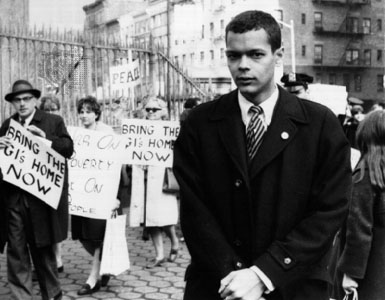


Ella Josephine Baker was a civil rights activist best known for her work with the National Association for the Advancement of Colored People (NAACP), the Southern Christian Leadership Conference (SCLC), and the Student Non-Violent Coordinating Committee (SNCC). Her emphasis on grassroots activism and her ability to work with several organizations and causes at a time made her one of the most effective leaders in the civil rights movement.
Ella Josephine Baker - African American Trailblazers
Ella Baker: The Mother of the Civil Rights Movement
Ella Josephine Baker (December 13, 1903 - December 13, 1986) was an African American civil rights and human rights activist beginning in the 1930s. She was a behind-the-scenes activist whose career spanned over five decades. She worked alongside some of the most famous civil rights leaders of the twentieth century, including: W.E.B. DuBois, Thurgood Marshall, A. Philip Randolph, and Martin Luther King Jr.
On the heels of regional desegregation sit-ins led by black college students, Baker persuaded the SCLC to invite southern university students to the Southwide Youth Leadership Conference at Shaw University on Easter weekend.
At this meeting the Student Nonviolent Coordinating Committee (SNCC) was formed. Following the conference Baker resigned from the SCLC and began a long and intimate relationship with SNCC. Along with Howard Zinn, Baker was one of SNCC's highly revered adult advisors. It was with Baker’s help that SNCC (along with Congress of Racial Equality) coordinated the region-wide freedom rides of 1961 and began to work closely with black sharecroppers and others throughout the South.


 Posts