Friday, April 30, 2010


Wednesday, April 28, 2010
Saturday, April 24, 2010
What The Problem Is
What The Problem Is
What The Problem Is
Blogtalk radio
"Political Analysis Lesson" with Brothah Mbanna Kantako.
Friday, April 23, 2010
Thursday, April 22, 2010
First Black Mayor of Columbia, SC

Steve Benjamin Elected as Columbia, SC Mayor

Voters in the South Carolina capital, Columbia, elected the city’s first black mayor. Mayor-elect Steve Benjamin won Tuesday’s runoff election by 56 percent of the vote. Earlier this month Benjamin won by a little over 1,000 votes, which was not the majority needed to avoid a runoff.
Known as one of the rising stars of the South Carolina Democratic Party, Benjamin ran in a heated race that brought out an unexpected 2,000 voters on election day. He ran against Councilman Kirkman Finlay who comes from a long line of Columbia politicians and who earned 44 percent of the vote.
Benjamin, 40, hails from Orangeburg, S.C. but spent his childhood in New York City. He obtained his undergraduate and law degrees from the University of South Carolina. He spent three years running the South Carolina Department of Probation, Pardon and Parole, leaving the agency for an unsuccessful run for attorney general in 2002.
 At his victory party, Diddy’s “All About the Benjamins” blared over a sound system as Benjamin and his family greeted well-wishers. In giving his acceptance speech, Benjamin noted an envelope in his pocket containing a $100 donation from his grandmother who died last month. He said, “She wanted to be here with us, and I know that she is.”
Wednesday, April 21, 2010
Notre Dame's first black valedictorian

Katie Washington, a biological sciences major from Gary, Ind., has been named valedictorian of the 2010 University of Notre Dame graduating class and will present the valedictory address during Commencement exercises May 16 (Sunday) in Notre Dame stadium.
Washington, who earned a 4.0 grade point average, has a minor in Catholic Social Teaching. She has conducted research on lung cancer at the Cold Spring Harbor labs and performed genetic studies in the University’s Eck Institute for Global Health on the mosquito that carries dengue and yellow fever. She is the co-author of a research paper with David Severson, professor of biological sciences.
Washington directs the Voices of Faith Gospel Choir at Notre Dame, is a mentor/tutor for the Sister-to-Sister program at South Bend’s Washington High School and serves as the student coordinator of the Center for Social Concerns’ “Lives in the Balance: Youth Violence and Society Seminar.”
Upon graduation, Washington plans to pursue a joint M.D./Ph.D program at Johns Hopkins University.
Tuesday, April 20, 2010
Remembering A Student Movement


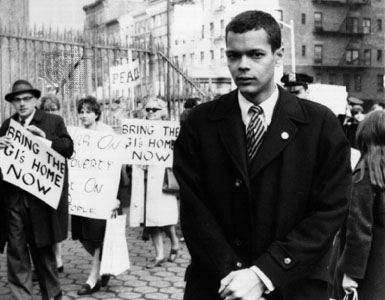


Ella Josephine Baker was a civil rights activist best known for her work with the National Association for the Advancement of Colored People (NAACP), the Southern Christian Leadership Conference (SCLC), and the Student Non-Violent Coordinating Committee (SNCC). Her emphasis on grassroots activism and her ability to work with several organizations and causes at a time made her one of the most effective leaders in the civil rights movement.
Ella Josephine Baker - African American Trailblazers
Ella Baker: The Mother of the Civil Rights Movement
Ella Josephine Baker (December 13, 1903 - December 13, 1986) was an African American civil rights and human rights activist beginning in the 1930s. She was a behind-the-scenes activist whose career spanned over five decades. She worked alongside some of the most famous civil rights leaders of the twentieth century, including: W.E.B. DuBois, Thurgood Marshall, A. Philip Randolph, and Martin Luther King Jr.
On the heels of regional desegregation sit-ins led by black college students, Baker persuaded the SCLC to invite southern university students to the Southwide Youth Leadership Conference at Shaw University on Easter weekend.
At this meeting the Student Nonviolent Coordinating Committee (SNCC) was formed. Following the conference Baker resigned from the SCLC and began a long and intimate relationship with SNCC. Along with Howard Zinn, Baker was one of SNCC's highly revered adult advisors. It was with Baker’s help that SNCC (along with Congress of Racial Equality) coordinated the region-wide freedom rides of 1961 and began to work closely with black sharecroppers and others throughout the South.


Thursday, April 15, 2010
Glary Utilities
I've been using Glary Utilities and thought you might like to try it to speed up your PC. Here's an invitation to download the wonderful tools of Glary Utilities Free Version /Pro Version.
To download now: http://download.cnet.com/Glary-Utilities/3000-2094_4-10508531.html
If you never heard about Glary Utilities, please visit www.glaryutilities.com. You will get a big surprise to explore one of the most popular and free PC optimization utilities which offers abundant services such as:
Optimize, clean and speed up your PC;
Simple and user friendly interfaces;
Protect your privacy & security;
Block spyware and adware;
Run fast and efficiently.
Since you are familiar with the user-friendly, powerful and free Glary Utilities, you can now visit http://download.cnet.com/Glary-Utilities/3000-2094_4-10508531.html to download it.
Once you download Glary Utilities, you will have no worry about any boring slow-down problems. You have become one member of the 10,000,000 end users who could enjoy the most customer-oriented product and considerate technical supports of Glarysoft lifelong.
Now Glary Utilities ranked the Fifth this week, please seehttp://download.cnet.com/windows/utilities-and-operating-systems/?tag=rb_content;contentNav .Why not have your say in improving the widely acclaimed Glary Utilities. Please feedback me what do you think of it. Thanks.
Thursday, February 18, 2010
Shani Davis wins gold
Shani Davis wins gold in men’s 1,000 meter speedskating
Shani Davis was born on Friday, August 13, 1982, in Chicago, Illinois. Raised by his mother on the city's south side, he started roller-skating at local rinks at age two. By age three Shani was darting around the roller rink so fast that skate guards would chase him just to ask him to slow down. Seeming to become bored with roller-skating, at age six a coach suggested that Shani switch to ice skating. Shortly thereafter, his mother started working for an attorney, Fred Benjamin, whose son happened to be involved in speed skating at an elite level. It was at that time that Benjamin suggested that Shani give speed skating a try.
Shani joined the Evanston Speedskating Club at age six and within two months started competing locally. Though immediately taking to ice, at competitions Shani was generally more interested in running around with his competitors and playing video games than he was with competing. Nevertheless, by age 8 he was winning regional age-group competitions and began to hear about the Olympic ideal from his Northbrook competitors and friends. Shani's mother encouraged him to participate and, in an effort to build his endurance, woke him most mornings to run a mile on a track close to their home. As there were -- and still are -- no speed skating clubs in inner city Chicago, at age 10 Shani and his mother moved to the far north side of the city to be closer to the Evanston rink.
Shani won five National Age Group Championships (1995, 1997, 1999, 2000, and 2003) and also won a North American Championship in 1999. Though Shani was the first black speed skater to earn a spot on the U.S. Olympic Team in 2002, Shani does not concentrate on making black history. Shani began making skating history at age 17 when he became the first U.S. skater to earn spots on both the short track and long track Junior World Teams and accomplished that feat three years in a row in 2000, 2001 and 2002. At 22, not only did Shani win his third consecutive U.S. All-Around Championship and Regional Qualifier (long track events), Shani became the first U.S. skater to make all three World Teams in the same season in the 2004-2005 (World Sprint, World All-Around and World Short Track), medaling at all three events, and ultimately winning the 2005 World Allround Championships held in Moscow, Russia in February 2005. At 23, Shani won Gold and Silver at the 2006 Olympics held in Torino, Italy and also repeated his World All-Around Title in March 2006 in Calgary. In 2006-2007 season, Shani won world titles in the 1000 meter and 1500 meter events. In the following season (2007-2008) Shani repeated his 1000 meter World Title. For this 2008-2009 season, Shani won his first World Sprint Title in Moscow and his third 1500 meter World Title and currently holds two world records (1000m and 1500m).
In 2006, Shani Davis became the first African-American to capture an individual gold medal at the Winter Olympics when he won the 1,000 meters in long-track speedskating, a feat that led him to be described as the Tiger Woods of the predominantly white sport. Davis has drawn comparisons to Eric Heiden, who won five Olympic gold medals in 1980 and is considered America’s greatest speedskater.


Wednesday, February 17, 2010
Tuesday, February 2, 2010
Rev. Pat Robertson & Rush Limbaugh! You are the Moral Judge
The historical impact of the Haitian Revolution allowed the U.S to Purchase Louisiana. If you research this you will see that when France lost Haiti they pretty much lost their money maker. The Louisiana territory which they still owned was then viewed as dead weight, and since France needed money for their renewed war with England Napoleon sold Louisiana on April 30, 1803 to the US for less than 4cents an acre. Public school wont tell you this.
Even Armstrong Williams could not take this !!!
Thursday, January 7, 2010
MOVE YOUR MONEY
MOVE YOUR MONEY
People all over the country are choosing to move their money out of bigger banks and into smaller, community-oriented financial institutions that generally avoided the reckless investments and schemes that helped cause the financial crisis.
Fueled by the personal initiatives of thousands, it’s a grassroots effort that has the potential to shift power in the financial system away from Wall Street and to Main Street.
Check out the video, read up on what inspired the idea, connect with others through Facebook and Twitter and then use the tools and links provided to find a community bank or credit union in your area
Move Your Money: A New Year's Resolution
Too-big-to-fail banks are profiting from bailout dollars and government guarantees, and growing bigger. Tell us which community bank you use, and why.
Last week, over a pre-Christmas dinner, the two of us, along with political strategist Alexis McGill, filmmaker/author Eugene Jarecki, and Nick Penniman of the HuffPost Investigative Fund, began talking about the huge, growing chasm between the fortunes of Wall Street banks and Main Street banks, and started discussing what concrete steps individuals could take to help create a better financial system. Before long, the conversation turned practical, and with some help from friends in the world of bank analysis, a video and website were produced devoted to a simple idea: Move Your Money.
The big banks on Wall Street, propped up by taxpayer money and government guarantees, have had a record year, making record profits while returning to the highly leveraged activities that brought our economy to the brink of disaster. In a slap in the face to taxpayers, they have also cut back on the money they are lending, even though the need to get credit flowing again was one of the main points used in selling the public the bank bailout. But since April, the Big Four banks -- JP Morgan/Chase, Citibank, Bank of America, and Wells Fargo -- all of which took billions in taxpayer money, have cut lending to businesses by $100 billion.
Meanwhile, America's Main Street community banks -- the vast majority of which avoided the banquet of greed and corruption that created the toxic economic swamp we are still fighting to get ourselves out of -- are struggling. Many of them have closed down (or been taken over by the FDIC) over the last 12 months. The government policy of protecting the Too Big and Politically Connected to Fail is badly hurting the small banks, which are having a much harder time competing in the financial marketplace. As a result, a system which was already dangerously concentrated at the top has only become more so.
We talked about the outrage of big, bailed-out banks turning around and spending millions of dollars on lobbying to gut or kill financial reform -- including "too big to fail" legislation and regulation of the derivatives that played such a huge part in the meltdown. And as we contrasted that with the efforts of local banks to show that you can both be profitable and have a positive impact on the community, an idea took hold: why don't we take our money out of these big banks and put them into community banks? And what, we asked ourselves, would happen if lots of people around America decided to do the same thing? Our money has been used to make the system worse -- what if we used it to make the system better?
Everyone around the table quickly got excited (granted we are an excitable group), and began tossing out suggestions for how to get this idea circulating.
Eugene, the filmmaker among us, remarked that the contrast between the big banks and the community banks we were talking about was very much like the story in the classic Frank Capra film It's a Wonderful Life, where community banker George Bailey helps the people of Bedford Falls escape the grip of the rapacious and predatory banker Mr. Potter.
It was a lightbulb moment. And, unlike the vast majority of dinner conversations, the excitement over this idea didn't end with dessert. It actually led to something -- thanks in great part to Eugene and his remarkable team, who got to work and, in record time, created a brilliant, powerful, and inspiring video playing off the It's a Wonderful Life concept. Watch it below.
Within a few days, the rest of the pieces fell into place, including an agreement with top financial analysts Chris Whalen and Dennis Santiago, who gave us access to their IRA (Institutional Risk Analytics) database. Using this tool, everyone will be able to plug in their zip code and quickly get a list of the small, solvent Main Street banks operating in their community.
The idea is simple: If enough people who have money in one of the big four banks move it into smaller, more local, more traditional community banks, then collectively we, the people, will have taken a big step toward re-rigging the financial system so it becomes again the productive, stable engine for growth it's meant to be. It's neither Left nor Right -- it's populism at its best. Consider it a withdrawal tax on the big banks for the negative service they provide by consistently ignoring the public interest. It's time for Americans to move their money out of these reckless behemoths. And you don't have to worry, there is zero risk: deposit insurance is just as good at small banks -- and unlike the big banks they don't provide the toxic dividend of derivatives trading in a heads-they-win, tails-we-lose fashion.
Think of the message it will send to Wall Street -- and to the White House. That we have had enough of the high-flying, no-limits-casino banking culture that continues to dominate Wall Street and Capitol Hill. That we won't wait on Washington to act, because we know that Washington has, in fact, been a part of the problem from the start. We simply can't count on Congress to fix things. We have to do it ourselves -- and the big banks are the core of the problem. We need to return to the stable, reliable, people-oriented approach of America's community banks.
So watch Eugene's amazing video, then go to www.moveyourmoney.info to learn more about how easy it is to move your money. And pass the idea on to your friends (help make this video -- and this idea -- go viral!).
JP Morgan/Chase, Citi, Wells Fargo, and Bank of America may be "too big to fail" -- but they are not too big to feel the impact of hundreds of thousands of people taking action to change a broken financial and political system. Let them gamble with their own money, not yours. Let's turn big banks into smaller banks. We'll all be better off -- and safer -- as a result.
Make it your New Year's resolution to move your money. We can't think of a better way to start 2010.
Thursday, December 31, 2009
Tuesday, December 29, 2009


Sunday, November 8, 2009
Some things you need to know
Alfred A. Edmond Jr.
BlackEnterprise.com Editor

Monday, November 2, 2009
Free the Scott Sisters.
Please put the petition on your page and encourage all your friends to sign. We can make a difference when we work together.
http://www.change.org/actions/view/free_the_scott_sisters_2
http://www.tagged.com/freethescottsisters
Learn more here - JUSTICE FOR ALL
http://www.ronsworldlife.com/
Friday, October 16, 2009
Just a little grove to help you feel your life move "good God" Maceo Parker plays Marvin Gaye "Let's Get It On" WE CAN CHANGE THE WORLD When we change our self, Then We can change our community, Then We can change our city or town, Then We can change our state, Then We can change our country, This will bring change to our world!!! We Are The Ones to make this change happen.......... ______________________ Love is the answer, A active love that makes us stand for justice, push for truth and shows Gods Power through the Love he gave us to share in this World. *************************** "review my blogs"


 Posts
Posts